Cervical Disc Herniation (Cervical Intervertebral Disc Herniation)
What is a cervical disc herniation?
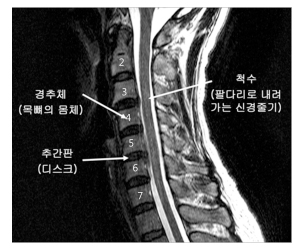
The cervical spine, or neck, is made up of seven bones. The disc (intervertebral disc) is the structure that normally sits between these seven vertebrae. It absorbs impact between the vertebrae and gives the spine stability, while at the same time allowing movement between them. A cervical disc herniation is when this disc protrudes and presses on a nerve (the spinal cord or a nerve root).
▶ SpineTube | Cervical Disc Herniation Explained ↗What causes cervical disc herniation?
Cervical disc herniation begins as a kind of degenerative change that comes with age. Degeneration of the disc usually starts after the age of 20; as the disc loses water content it loses elasticity, so minor trauma or long-standing poor posture can push the disc backward onto the nerve. Bone spurs growing from the joints of the cervical vertebrae can press on the nerve as well, and either route produces a cervical disc herniation.
What symptoms does cervical disc herniation cause?
Symptoms of cervical disc herniation can be broadly divided into three types.
They are: (1) cervical pain (neck pain), (2) radiculopathy — the symptoms that appear when a nerve root is compressed, and (3) myelopathy — the symptoms that appear when the spinal cord is compressed (described separately in detail later). However, not all neck or arm pain is a cervical disc herniation. Cervical disc herniation is only one of the many conditions that can make the neck and arm hurt.
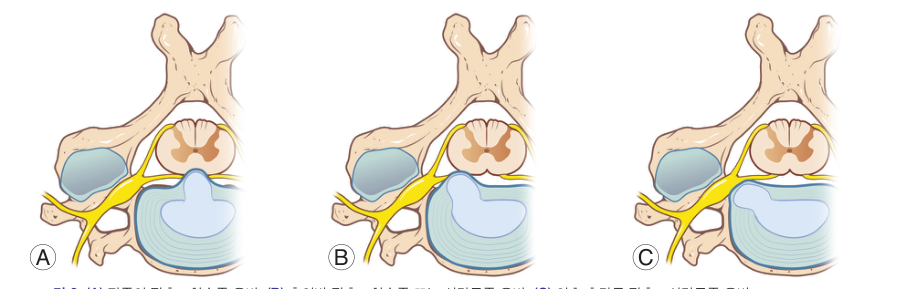
A. Central Herniation — Causes Myelopathy
B. Posterolateral Herniation — Causes Myelopathy or Radiculopathy
C. Lateral Foraminal Herniation — Causes Radiculopathy
(1) Cervical pain often worsens when you raise your head to look up. The problem lies in the neck, but the pain can spread beyond the neck to the area around the shoulder, the shoulder blade, and the back of the head, and it can also bring on a headache.
(2) Radiculopathy is the set of symptoms caused when protruding disc material or bone presses on a nerve root, and it divides broadly into sensory symptoms and motor symptoms. The common sensory symptom is pain running from the shoulder down the arm to the hand, called radiating pain. It may feel like numbness or pulling, and in severe cases like being cut with a knife.
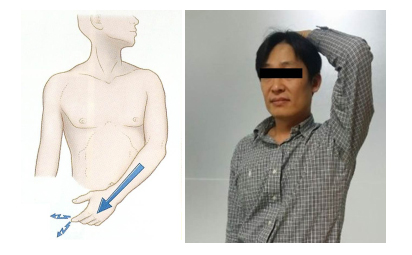
This pain often worsens when you look up and turn your head toward the painful side, and it is frequently relieved when you place the hand of the painful side on the back of your head. Sensation may become dull, or an odd feeling may appear when the area is touched, as though sand were spread over the skin. Motor symptoms are relatively uncommon in radiculopathy; they mean weakness, a loss of strength in the arm.
How is cervical disc herniation diagnosed?
When these symptoms are present, diagnosis begins with a careful history, physical examination, and neurological testing. Imaging such as plain X-ray or CT may be used, but MRI is the most accurate method. Electromyography (EMG), which tests nerve function, is sometimes performed as well. As a rule, however, an expensive MRI is not ordered from the outset: it is done only when the examination strongly suggests a cervical disc herniation and the result will help decide the direction of treatment.
What conditions must be differentiated from cervical disc herniation?
Cervical disc herniation must be distinguished from problems of the shoulder joint itself, which can also cause neck and shoulder pain. Numbness in the arm must be distinguished from conditions in which a peripheral nerve is compressed, such as thoracic outlet syndrome, brachial plexus injury, ulnar nerve palsy, and carpal tunnel syndrome. When sensation or strength is reduced in one arm, early stroke and amyotrophic lateral sclerosis (ALS, commonly known as Lou Gehrig's disease) must be ruled out. Fibromyalgia can also present with neck and shoulder pain.
How is cervical disc herniation treated?
For both preventing and treating cervical disc herniation, keeping good posture at all times matters most.
For mild symptoms, medication and short-term immobilization with a brace are usually enough, and physical therapy such as heat therapy, deep ultrasound therapy, electrical stimulation, and traction is effective.
The specific treatment differs according to the three kinds of symptoms described above.
(1) Cervical pain is treated non-surgically as a rule. This means resting the neck with a brace, hot and cold packs, and muscle relaxants or anti-inflammatory painkillers. For chronic neck pain, resistance exercise to strengthen the neck muscles, stretching, and good posture all help.
(2) Radiculopathy responds very well to non-surgical treatment in most cases. Non-surgical treatment for radiculopathy includes medication, physical therapy, and injection therapy.
a. Medication uses anti-inflammatory painkillers, drugs that act on the nerves, and muscle relaxants.
b. Physical therapy uses electrical stimulation, superficial heat, deep heat, and traction.
c. Injection therapy usually means a nerve root block or an epidural block, often described more simply as a nerve injection or nerve treatment. In most cases a powerful anti-inflammatory steroid is injected around the nerve, and the pain relief is excellent. Sometimes, though, it does not work, or the pain returns over time after an initially good response. In that situation the injection can be repeated up to about three times in six months, but caution is needed beyond that, because more frequent injections can cause side effects.
d. As described, radiculopathy is usually resolved well by non-surgical treatment, but surgery is sometimes necessary. Surgery is performed when pain is severe enough to interfere substantially with daily life despite proper treatment, when non-surgical treatment has failed for six weeks or more, or when motor nerve involvement has already caused marked weakness or the weakness is getting worse. Severe or worsening motor paralysis is very rare, but when it does happen the rule is to operate before it is too late.
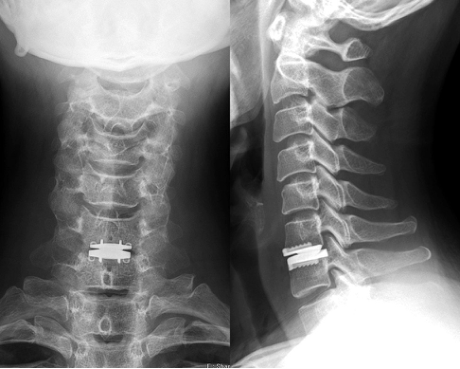
Surgical methods vary, but the most widely used is anterior cervical decompression and fusion: the front of the neck is opened, the disc and any protruding bone are removed, bone from the pelvis or an artificial bone-fusion material is placed between the vertebrae, and the segment is secured with a metal plate. Decades of experience have proven this operation effective, and at present it is the best standard surgical method. Instead of fusion, an artificial disc can be placed. Long-term results were once hard to judge, but several studies have now followed patients for four to six years after surgery. In these studies the artificial disc gave results comparable to fusion, and it did somewhat better on the rate of repeat surgery and on wear of the segments above and below. How long an artificial disc holds up inside the body still needs longer follow-up, however, and it is not suitable for every patient, so the choice is made together with your surgeon. Other options include foraminotomy and endoscopic surgery, which may be selected according to the patient and the location and state of the lesion.
Medical review: Cervical Spine Research Society · Provided by the Korean Society of Spine Surgery