What is Spinal Stenosis?
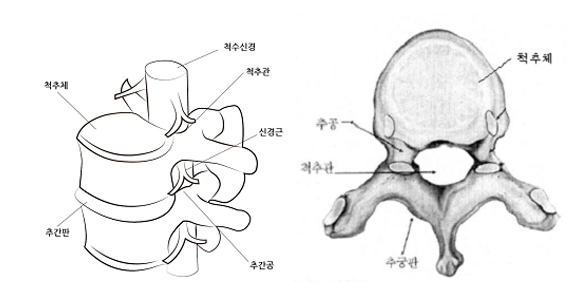
To understand spinal stenosis, you must first learn about the shape of the spine in your body. In the image below, the left diagram shows the spine from the side, and the right diagram shows the spine viewed from above. The spine is composed of vertebral bodies at the front and the spinal canal at the back. These bones stack to form the vertebral column. Between adjacent vertebrae are intervertebral discs, and the spinal canal creates the passageway where spinal nerves travel. This passageway through which the spinal nerves pass is called the spinal canal. When the spinal canal narrows for any reason, it causes a condition called spinal stenosis.
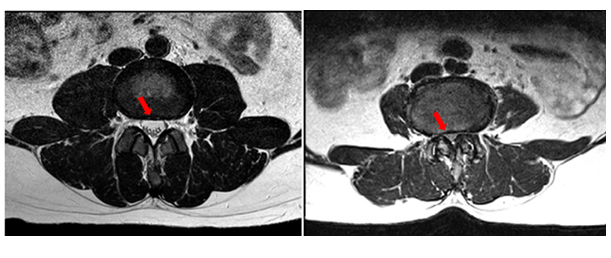
This is an MRI image. The red arrow indicates the spinal canal, and the black circular structure is the vertebral body. Comparing this with the diagram on the left above will help you understand better. The left image shows a normal spinal canal with a small point-like structure inside representing the nerve. The right image is an MRI of a spinal stenosis patient where the spinal canal has narrowed due to degenerative changes in surrounding ligaments and bone, compressing the nerve.
Why does Spinal Stenosis occur?
Based on the cause of onset, spinal stenosis is classified into congenital and developmental stenosis, or acquired and degenerative stenosis.
1) Congenital and Developmental Stenosis
Some people are born with a naturally narrow spinal canal. For example, conditions like achondroplasia, which may cause few symptoms in youth but typically present with stenosis symptoms at a relatively young age, usually in the early 30s. In these cases, symptoms are often severe, and surgical treatment is much more difficult than with acquired stenosis. 2) Acquired and Degenerative Stenosis The spine, like other joints, develops arthritis and degenerative changes with age. When these degenerative changes narrow the spinal canal, stenosis occurs. Due to degenerative changes in spinal joints and discs, surrounding ligaments and bones thicken, narrowing the spinal canal and compressing the nerves inside, causing various symptoms. This most commonly occurs between the 4th and 5th lumbar vertebrae and is more prevalent in women.
2) Acquired and Degenerative Stenosis
The spine, like other joints, develops arthritis and degenerative changes with age. When these degenerative changes narrow the spinal canal, stenosis occurs. Due to degenerative changes in spinal joints and discs, surrounding ligaments and bones thicken, narrowing the spinal canal and compressing the nerves inside, causing various symptoms. This most commonly occurs between the 4th and 5th lumbar vertebrae and is more prevalent in women.
What symptoms does Spinal Stenosis cause?
The most characteristic symptom patients report is that both legs hurt or feel numb when walking, making it difficult to walk for long distances. Pain usually radiates from the buttock area toward the knee, and patients often describe it as 'feeling like my buttock is going to fall out' or 'my calf feels like it's going to burst.' At this point, sitting on a chair or squatting relieves the symptoms, allowing the patient to walk again. As the condition worsens, the distance the patient can walk at one time progressively decreases, and daily life becomes difficult. In early stages, there may only be vague discomfort in the lower back or buttock area that patients tolerate, but as the disease progresses, the symptoms described above appear, prompting the patient to seek medical care. In more severe cases, patients may report weakness in the legs and difficulty with urination.
How is Spinal Stenosis different from a herniated disc?
Both herniated discs and spinal stenosis involve nerve compression from the lower back extending to the legs, causing leg numbness and difficulty walking, which is similar. However, in a disc herniation, the soft nucleus pulposus compresses the nerve and causes symptoms, while in spinal stenosis, hard tissues such as bone and ligaments compress the nerve. Disc herniation can occur acutely at any age, whereas stenosis typically develops slowly at a relatively older age. There is also a difference in symptoms: a disc herniation does not improve with squatting, but stenosis improves with squatting and resting. Additionally, with a disc herniation, it is difficult to raise the leg while lying flat, but this symptom does not occur with stenosis.
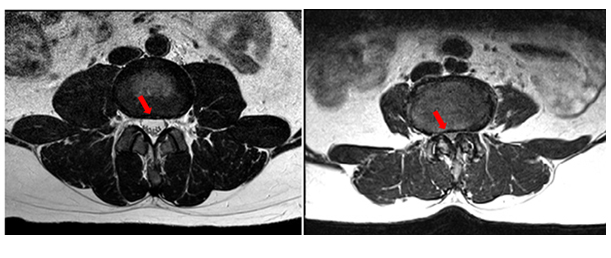
The red arrow in the left image below shows a disc herniation compressing the nerve, while the red arrow in the right image shows narrowing of the spinal canal due to changes in the shape of surrounding ligaments and bone.
How is Spinal Stenosis diagnosed?
When a patient first visits the hospital with characteristic symptoms of spinal stenosis and physical examination suggests stenosis, imaging studies are performed. Initially, an X-ray is taken to check for degenerative changes or instability in the spinal joints, and to identify any disc space narrowing. Further imaging may include myelography, CT, electrodiagnostic testing such as electromyography (EMG), and MRI, of which MRI is the most accurate and superior imaging method.
MRI allows direct visual confirmation of the narrowed spinal canal compressing the nerve and identification of the cause of stenosis. It plays a crucial role in determining the treatment approach by considering both the patient's symptom severity and imaging findings.
Do I need surgery if I'm diagnosed with Spinal Stenosis?
Unlike disc herniations, symptoms do not progress acutely, and severe neurological deficits are rare. Because symptoms progress gradually, there are few cases requiring immediate surgery. Depending on symptom severity, conservative treatment is typically attempted first, and surgery is considered only when conservative treatment is ineffective.
1) Conservative Treatment
Spinal stenosis occurs when the nerve is compressed by surrounding bone or ligaments, reducing blood circulation to the nerve and causing inflammation, which creates pain in the buttock and leg areas. While the definitive treatment is to remove the cause compressing the nerve and widen the passageway for the nerve, this requires surgery and can burden the patient in various ways. Since stenosis develops in elderly patients, surgical treatment must be carefully considered, and conservative treatment is attempted first. As mentioned earlier, pain arises not only from nerve compression but also from inflammation of surrounding tissue, so conservative treatment aims at reducing this inflammation.
Resting in bed alone can improve symptoms to some degree, but lying down for more than a week negatively affects both mental and physical health and should be avoided when possible. Also avoid severely extending the back or lifting heavy objects.
Medications used include anti-inflammatory drugs, pain relievers, and muscle relaxants. When used alongside bed rest as mentioned earlier, these medications are effective for acute pain. Additionally, there are medications that improve blood circulation and relieve pain.
Physical therapy includes exercises to strengthen abdominal and lower back muscles to better support the spine. Cycling and walking on inclines are helpful. However, physical therapy alone without medications or injections is less effective, so combining treatments is recommended.
When basic treatment does not provide relief, there is nerve block treatment, where a potent anti-inflammatory steroid is injected directly around the nerve. While very effective for both diagnosis and treatment, complications such as infection can occur, so it must be used carefully. If the patient does not respond to all these treatments, surgery is considered.
2) Surgical Treatment
Surgical treatment widens the narrowed nerve passageway to free the compressed nerve, referred to as 'decompression.' Freeing the nerve alone is sometimes sufficient, but in cases of severe degenerative changes, not only bone and ligaments but also spinal joints must be removed to achieve adequate decompression. In such cases, surgery to stabilize the spine must be performed together. Stabilization surgery involves fixing two or more vertebral segments with screws and grafting bone to fuse them together, called 'fusion.'
In summary, surgical treatment can be divided into two main types: decompression alone, or decompression combined with fusion. Some patients worry that fusion will prevent spine movement, but because adjacent segments can compensate to some degree, significant restriction of movement does not occur. The screws inserted during surgery, if causing no problems, do not need to be removed in a separate procedure.
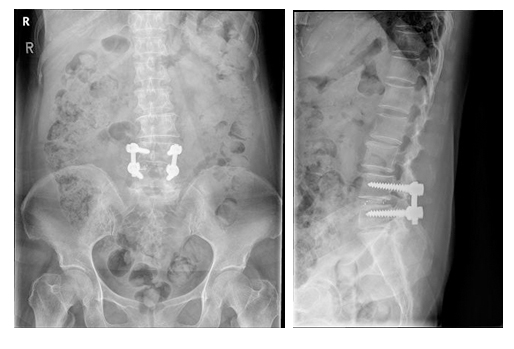
Image showing decompression and fusion surgery performed together for a spinal stenosis patient
What happens if I don't get treatment?
In fact, research on spinal stenosis patients who receive no treatment is rare, so the exact course is unknown. However, some research results show that among patients who did not have surgery, symptoms rarely improved or worsened suddenly. Even with severe stenosis, serious neurological deficits such as paralysis or bowel/bladder dysfunction rarely occur acutely from stenosis alone without other conditions. Therefore, surgical treatment can be safely delayed while pursuing conservative treatment, and the decision should be based on how much the symptoms affect the patient's daily life rather than imaging findings alone.
Will symptoms recur after surgery?
Recurrence is possible. Recurrence can occur at the surgical site or above or below the surgical area. At the surgical site, recurrence can happen if decompression alone was performed and the removed bone grows back, compressing the nerve again. In this case, revision surgery with wider decompression must be performed. Therefore, fusion is often necessary during revision surgery.
If decompression and fusion were performed together in the first surgery, the fused segment cannot move, so the segments immediately above and below move more, which can lead to recurrent stenosis.
Ultimately, recurrence can occur whether decompression alone or decompression combined with fusion is performed. Various new surgical techniques are being introduced to address these issues, but long-term outcome data for newer procedures is still lacking.
Medical review: Lumbar Spine Research Society · Provided by the Korean Society of Spine Surgery