Adolescent Scoliosis
Have you ever heard at a Korean medicine clinic or fitness center that your child's pelvis is tilted or shoulders are slanted, and worried whether your child has spinal curvature? Let me discuss the misconceptions and truths about scoliosis.
What is 'scoliosis'?
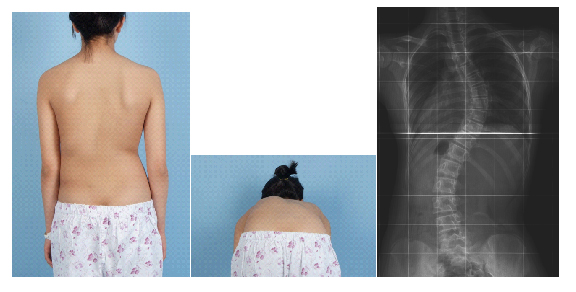
Normally, the human spine appears as a straight line when viewed from the front, and when viewed from the side, the waist curves inward and the back curves outward in an 'S' shape. However, there are cases where the spine curves sideways when viewed from the front, and when the spine appears as an 'S' or 'C' curve when viewed from the front-to-back direction, this is called 'scoliosis'. 'Scoliosis' is not simply caused by poor posture, so it does not straighten when one maintains an upright posture or leans against something.
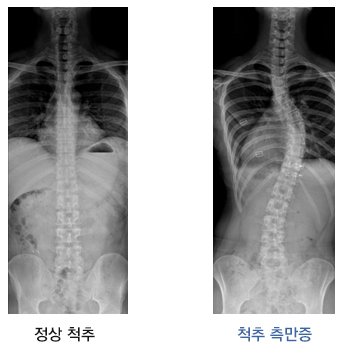
What types of 'scoliosis' are there?
'Scoliosis' is divided into cases where the cause of curvature is known and cases where the cause is still unknown. In many cases of scoliosis in adolescent girls, the cause of scoliosis has not yet been determined, and these cases are called 'idiopathic scoliosis'. 'Idiopathic scoliosis' is classified by the age at which scoliosis is discovered: 'infantile type' when discovered before age 3, 'juvenile type' when discovered between ages 3 and 10, 'adolescent type' when it develops between age 10 and completion of growth, and 'adult type' when discovered after growth is complete. Cases with known causes include 'congenital scoliosis' caused by vertebral anomalies during fetal development, 'neuromuscular scoliosis' caused by neurological abnormalities such as cerebral palsy, and scoliosis caused by genetic diseases.
Is 'scoliosis' a common disease?
Actually, 'scoliosis' is a very rare disease. In 'adolescent idiopathic scoliosis', cases with curvature of 20 degrees or more occur in approximately 3 per 1,000 people, and cases with 30 degrees or more occur in 1 per 1,000 or fewer. This is a rare condition. It is sometimes said that modern adolescents are more prone to scoliosis due to less exercise and more sitting time at academies compared to the past, but this is unfounded gossip, and in fact, domestic studies show that the prevalence of adolescent scoliosis was the same in 1980 and 2007. Not all cases where the waist appears curved on X-ray are scoliosis. If someone has back pain or discomfort, even a normal person may appear to have curved waist on X-ray, so if scoliosis is suspected, it is best to receive an accurate diagnosis from a specialist.
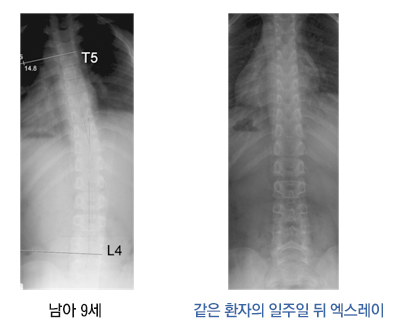
Why does 'scoliosis' develop?
It is known that scoliosis does not develop because of lack of exercise or poor posture. Rather, poor posture may be a result of scoliosis. A slight difference in leg length does not cause scoliosis. 'Adolescent idiopathic scoliosis', which accounts for approximately 80% of scoliosis, still has no clearly identified cause. It is more common in girls than boys, occurring 5-7 times more frequently, and occurs more frequently when there is a family history of scoliosis, suggesting a genetic component, but the genes causing scoliosis have not been clearly identified. Growth velocity significantly affects the progression of scoliosis angle. During adolescence (ages 10-15 in girls, 13-18 in boys), height grows rapidly, and scoliosis progresses and worsens during this period. If height grows at a rapid rate, the angle also progresses rapidly; if height grows slowly, the angle worsens slowly, and once the growth plates close and growth ends, the angle does not progress further unless it is very severe.
What problems can occur if there is 'scoliosis'?
The greatest problem with 'scoliosis' is that 'it looks aesthetically unpleasant'. It is commonly said that scoliosis causes back pain or compresses the lungs and organs, impairing breathing or digestion, but this occurs only in cases with very large angles, and functional abnormalities are rare. In fact, Usain Bolt, the fastest runner in the world, has scoliosis.
Of course, the body shape gets somewhat worse as the spine curves. Fortunately, however, curvature of 20-30 degrees is not obviously noticeable to the average person. Regarding back pain, patients with 'scoliosis' not only experience back pain more often than the general population, but also tend to have pain that is more severe or that recurs more frequently. If there is severe pain that interferes with activity, testing is needed to check if there is another cause or disease besides 'scoliosis'. Lung or organ compression leading to functional abnormalities occurs with very severe scoliosis. Pulmonary dysfunction begins to occur with curves greater than 70 degrees, and symptoms may develop with curves greater than 100 degrees.
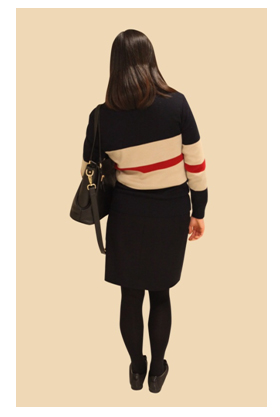
How can you tell if you have 'scoliosis'?
In scoliosis, occasionally shoulder height or waist line may be asymmetrical, but in most cases poor posture habits are more common, and most patients cannot detect obvious curvature until it becomes severe. If school screening suggests possible 'scoliosis', the best course is to receive diagnosis from a specialist. The examination first looks from behind the patient to check if the spine is straight and whether there is structural asymmetry in shoulder height and waist line, and whether the torso is twisted. Next, the patient bends forward 90 degrees at the waist, and from behind, the examiner checks for protruding parts in the back or waist caused by vertebral rotation. Finally, X-ray examination over the entire spine is performed to measure the angle of curvature. Some patients report that the measured angle differs from hospital to hospital, but X-ray measurement has an error range of ±5°, so the angle may vary with each X-ray.
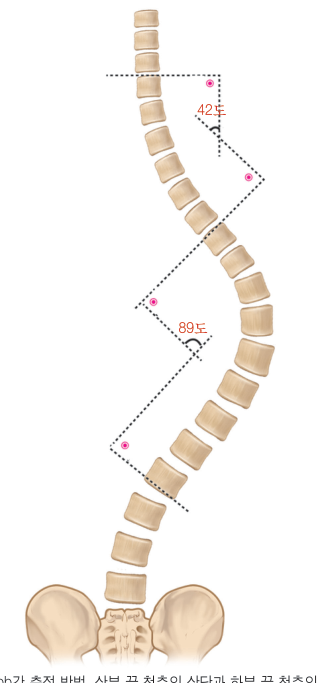
Can 'scoliosis' straighten on its own?
'Scoliosis' is structurally a curved spine and does not straighten on its own. In cases of mild scoliosis, no treatment is necessary and it does not interfere with normal life, but it does not straighten again. As long as the child does not experience pain, any exercise such as basketball or soccer is fine. Exercise actually makes the body healthier, so it is good to exercise regularly.
How should 'scoliosis' be treated if present?
In most scoliosis patients, the degree of curvature is very mild, so approximately 90% of patients do not require special treatment. However, adolescents in rapid growth periods may have progression of scoliosis depending on growth rate, so periodic X-ray examinations are necessary. Generally, scoliosis between 25-50 degrees often requires treatment, so specialist examination is necessary. If imaging shows high risk of angle progression, treatment such as bracing may be needed and surgical treatment may be necessary. Cases with 50 degrees or more of scoliosis require surgical treatment to restore normal posture. Corrective treatment, exercise therapy, or manual therapy and other non-surgical methods claimed to straighten the spine are not scientifically proven to be effective and are not recommended. Common sense also suggests that just as dental braces cannot correct teeth using these methods, it is nearly impossible to correct larger bones of the spine using these methods.
What is bracing?
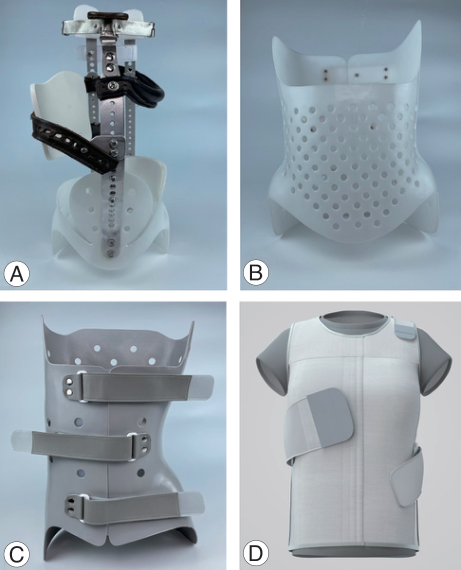
A brace is a plastic armor-like device. It applies pressure to the area of curvature to prevent the angle from progressing further. However, bracing cannot straighten what is already curved. If significant growth remains and there is 20-40 degrees of curvature, or if periodic X-ray imaging shows progressive worsening, progression is likely, and bracing may be considered. Braces come in various types depending on design and wear time. While the effectiveness of bracing has been questioned recently, the biggest problem is the psychological stress it causes when placed on adolescent girls. Particularly with braces requiring 24-hour wear, marks show even under clothes, which can inhibit the child's school life. Therefore, when deciding whether to use a brace and which type to choose, not only scoliosis should be considered but also the child's personality and activity level, so consultation with a specialist is essential.
When is surgery done and how?
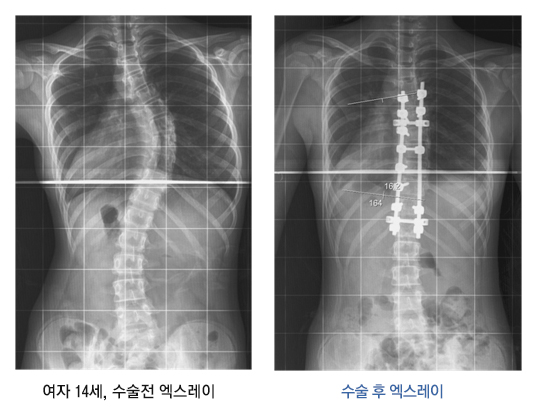
Surgery is performed for very severe scoliosis. Generally, if the angle exceeds 50 degrees, it continues to worsen even after growth ends and may become aesthetically problematic, so surgery is needed. Also, in growing children, if the angle exceeds 40 degrees or continues to worsen despite bracing, surgical treatment may be necessary. In such cases, multiple factors should be considered to decide on surgery, so consultation with a spine specialist is essential.
Surgery involves fusion by inserting screws into each vertebra and connecting them with long rods to achieve correction, followed by bone grafting. The degree of correction depends on how flexible the scoliosis is. Since the spinal cord, a bundle of nerves running from the brain to the legs, passes through the vertebral column, over-correction is avoided and correction is maximized within the range of avoiding nerve damage. Because this is surgery in a dangerous area, surgery itself carries risks. However, spine surgeons are trained to safely operate in these dangerous areas, so problems actually occur rarely.
Conclusion
As explained above, scoliosis is not a very serious or dangerous disease. In one word, it is a disease where the waist looks less attractive. People commonly think the back hurts because the spine is curved, but back pain does not occur with 20-30 degrees of curvature. For example, if your head hurts, it is not because your face looks bad. Your head hurts because you are stressed or stayed up all night working. The same is true for the back. The back hurts because you sit for long hours or have weak muscles due to lack of exercise, not because the spine is curved. Scoliosis occurs most commonly in teenage girls. This is an age when sensitivity is heightened and interest in appearance is high. If parents worry too much and pay too much attention to mild scoliosis at this age, it can hurt the child and cause psychological inferiority. Of course, parents' hearts ache at the development of scoliosis and want to do better by the child, but parents should only think this in their hearts and never show it to the child. Console the child that scoliosis is not a major problem and encourage the child to develop other strengths. Also, caution the child about spending long hours playing games while sitting, and even if busy with studies, encourage exercise one or two days a week to maintain spinal health.
Medical review: Spinal Deformity Research Society · Provided by the Korean Society of Spine Surgery