What is lumbar fusion and when is it needed?
In cases of spinal stenosis or spondylolisthesis requiring surgery, surgery widens the narrowed spinal canal, releasing the nerve long compressed within the narrowed canal, called decompression. This is the most important part of spinal stenosis surgery, and for many patients this alone is sufficient. However, patients with severe widespread nerve compression require removal of much bone and joint during decompression, making the spine unstable. In such cases, if unstable spine segments are left as is, various problems arise, so lumbar fusion is necessary in unstable segments. Lumbar spine fusion is accomplished through metal fixation using metal devices (screws) and bone grafting.
What is minimally invasive lumbar fusion?
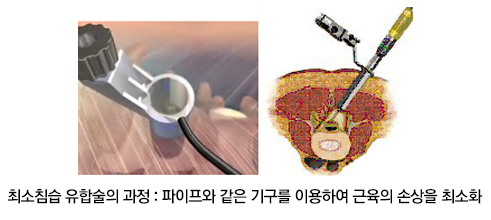
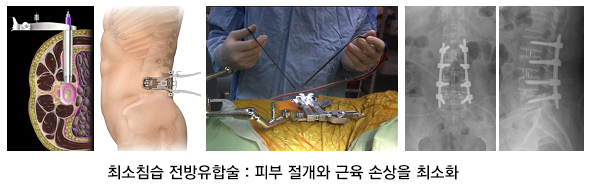
Traditional conventional fusion requires extensive skin incision and muscle retraction. This causes intraoperative bleeding and muscle damage, potentially resulting in post-operative pain and prolonged rehabilitation periods. Minimally invasive fusion uses various instruments to minimize skin incision, muscle retraction and damage. In most cases, surgical microscopes are used allowing more precise surgery. Usually 3-4cm skin incisions and tube-like instruments are inserted to perform surgery, and screws are also inserted through this opening, resulting in minimal skin incision and muscle damage. This results in less intraoperative bleeding, less post-operative pain, and shortened rehabilitation periods.
What types of minimally invasive lumbar fusion are there?
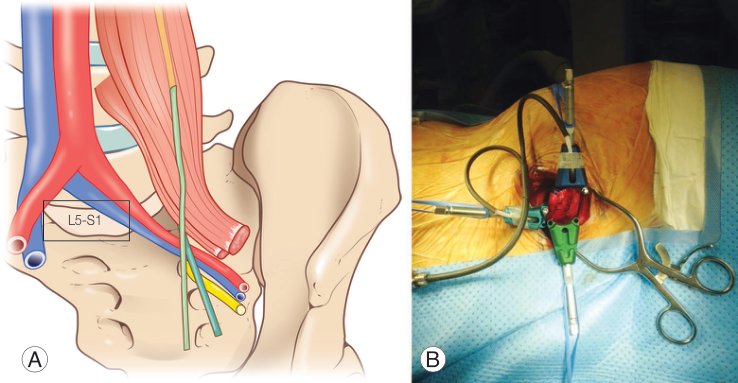
Minimally invasive fusion divides into anterior and posterior fusion like conventional lumbar fusion, and recently both posterior fusion and anterior fusion proceed using minimally invasive methods. Anterior fusion is performed by approaching laterally through the flank. Compared to traditional anterior fusion, it has advantages of smaller skin incision and less bleeding.
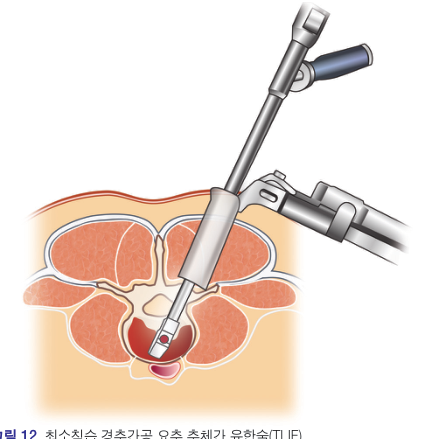
Within minimally invasive fusion there are several named techniques. The most commonly used is an approach from the back, in which a small working channel is made, the disc is cleared out and bone is packed into that space (minimally invasive TLIF, or MIS-TLIF). There is also lateral fusion, approached through the flank, and an approach taken on an oblique line between the flank and the abdomen (oblique lumbar interbody fusion, or OLIF). Screws are placed through small skin punctures as well (percutaneous screw fixation). Which method is used is decided by looking at where and how severely the nerve is compressed, how far the spine is curved or slipped, and what surgery has been performed before.
What are the disadvantages of minimally invasive lumbar fusion?
Clinical results and indications are similar to conventional surgery. Cost is no different from conventional surgical methods. However, very severe pathology may have limited applicability. Also, surgery takes somewhat longer and requires special surgical instruments and extensive intraoperative use of imaging equipment, which are disadvantages.
Medical review: Minimal Invasive Surgery Research Society · Provided by the Korean Society of Spine Surgery