The 'hunched grandmother', 'hunchback deformity', a spinal deformity familiar to the general public but not well understood with much misinformation. The appearance suggests a serious problem, but seeing people live their entire lives in this condition also suggests it is not a serious problem. In medical terminology, it is called kyphosis, a spinal deformity. Let me clarify the misconceptions and truths about this.
First, what is kyphosis? It refers to a state where the spine is pathologically excessively bent forward.
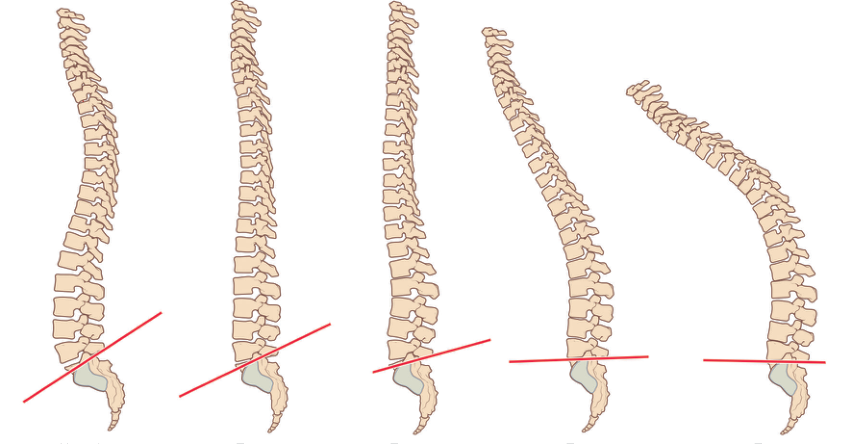
The spine serves as a 'column' supporting the torso and maintaining balance. To maintain these functions well, normally when a person's spine is viewed from the side, it is convex forward at the neck (cervical) and lower back (lumbar) and convex backward at the back (thoracic), and overall maintains balance with the center of the head's weight passing through the center of the pelvis. This spinal structure and balance requires the least energy for humans to maintain an upright posture. You can easily understand this by thinking that walking with a bent waist is much more difficult than walking with a straight waist.
A change in this normal spinal structure is called spinal deformity, and conditions such as scoliosis and kyphosis are forms of these spinal deformity diseases. Among these, kyphosis refers to a state where abnormal backward convexity increases, and while a bent appearance of the back is common, kyphosis can also develop in the neck or waist.
What problems occur with kyphosis? Limitation or impairment of upright function and walking function can occur.
When kyphosis becomes severely pathological, the normal sagittal (side-view) balance of the spine is lost, the center of gravity shifts forward, and it becomes difficult to maintain an upright posture, a condition called sagittal imbalance. As kyphosis becomes excessive and it becomes difficult to maintain the center of gravity without falling forward, the time that can be spent standing or walking decreases, and fatigue in muscles maintaining upright posture increases, potentially causing back pain. Also, if severe kyphotic deformity causes the body to tilt forward, additional unnecessary efforts are made to maintain upright posture by puffing out the chest, tilting the pelvis back, and bending the knee joints, making walking and maintaining upright posture even more difficult.
Why does kyphosis occur? There are various causes.
Causes range from those related to posture and habits to those from aging and degenerative changes like in 'hunched grandmothers', and also cases where vertebral body deformities occur from fractures, ankylosing spondylitis, congenital anomalies, infection, or tumors. There are also cases where spinal nerves and muscles that maintain spinal balance fail to function properly due to Parkinson's disease or other neurological conditions.
Often, postural kyphosis where a habitually hunched posture is assumed is mistaken for pathological kyphosis, but the biggest difference is that when one is conscious and stands upright, the deformity is corrected, unlike in pathological kyphosis.
It is also necessary to distinguish between senile kyphosis caused by normal aging processes and pathological situations that interfere with daily living and cause serious functional decline. It is a natural phenomenon that kyphosis increases to some degree as people age due to degenerative changes from aging, where the height of discs (intervertebral discs) connecting each vertebral segment decreases and the muscle strength supporting the spine weakens. However, if the degree of deformity is severe enough to interfere with daily living, treatment should be considered. The natural course varies depending on the cause of kyphosis, which is an important factor to consider when determining treatment necessity and method.
What types of kyphosis are there?
Degenerative kyphosis: Can appear with degenerative scoliosis, or like lumbar degenerative kyphosis commonly observed in rural elderly women in Korea and Japan, kyphosis appears in the lumbar region which should normally be in lordosis, mainly related to muscle degeneration. This is presumed to be related to sitting-style living habits and squatting work habits. Four typical symptoms are body bending forward when walking, inability to hold heavy objects in front, needing to lean on elbows when standing work, and difficulty climbing uphill. If accompanied by spinal stenosis, leg numbness may also occur.
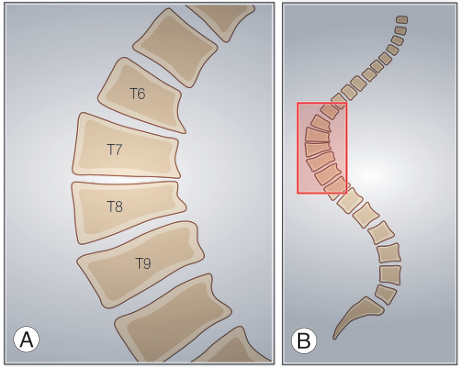
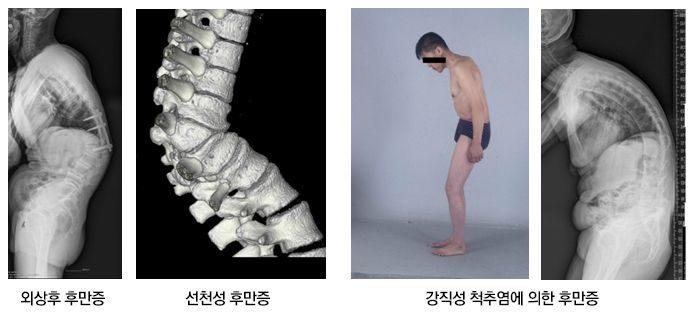
Post-traumatic kyphosis: Can occur when vertebral fracture results in a wedge-shaped flattening of the anterior portion, and the kyphotic deformity heals in that position. With the aging population increasing and osteoporosis prevalence rising, vertebral body fractures are also increasing. If mild kyphotic deformity occurs in one vertebra, remaining vertebral segments can compensate to maintain balance, but if severe deformity occurs or multiple vertebral fractures leave kyphotic deformity, the overall spinal balance tilts forward and balance can be lost.
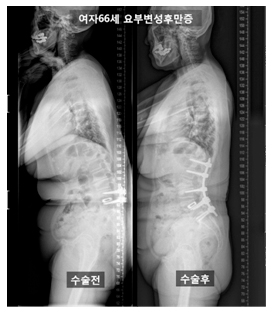
Post-surgical kyphosis: Mainly in the lumbar region, long fusion spanning multiple segments, kyphosis can develop over time and aging as muscle strength maintaining spinal balance decreases.
Ankylosing spondylitis: In a small subset of patients with ankylosing spondylitis, severe spinal deformity may occur, sometimes resulting in severe kyphosis where patients cannot lift their head and look forward.
Congenital spinal anomaly: In rare cases, if vertebral bodies do not develop normally from birth due to spinal anomaly, spinal deformities such as scoliosis and kyphosis may appear.
Scheuermann's kyphosis (adolescent kyphosis): Often discovered in adolescence, patients commonly present with conspicuous rounded appearance of the back, and rarely report pain.
The name was first reported by Scheuermann, a Danish physician.
Spinal tuberculosis and post-infectious sequelae: If spinal tuberculosis or other infection before growth completion damages growth plates and other parts of vertebral bones, asymmetric vertebral bone growth can occur, potentially resulting in spinal deformities such as kyphosis and scoliosis as growth progresses. The 'hunchback' deformity often falls into this category.
Neurological disease such as Parkinson's disease: Parkinson's disease impairs balance maintenance and motor function not only of the spine but throughout the body, and can induce posture similar to spinal kyphosis. However, because the cause is not limited to the spine, it is called camptocormia and is characterized by appearing when standing or walking but straightening when lying down. Because the cause is not limited to a spinal problem, the treatment principles also differ from spinal kyphosis.
What are the main symptoms of kyphosis and when should a specialist be consulted? When there are aesthetic problems, pain, and walking function limitations.
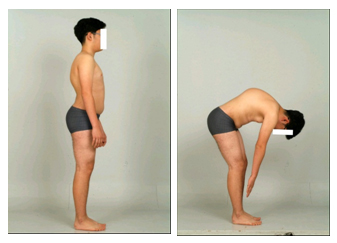
Generally, the problems most commonly associated with spinal kyphosis include three representative ones: aesthetic problems with posture, pain, and functional problems with upright posture including walking limitations. Aesthetic problems can be confirmed by observing protruding back when leaning forward as shown in the figure. Spinal kyphosis in newborns with congenital spinal anomalies as the main cause is most commonly identified through pediatric examination and simple radiography and referred to orthopedic spine specialists. In adolescents, Scheuermann's kyphosis is typical, but congenital kyphosis and others may be discovered late, and patients commonly present with the chief complaint of conspicuous rounded back appearance. In adults, many visit orthopedic clinics when experiencing back pain or functional changes such as inability to stand upright due to forward body tilt.
Also, in adolescents already known to have congenital spinal kyphosis during periods of rapid growth, or in adults with kyphosis from spinal tuberculosis sequelae where vertebral deformity progresses with degenerative changes, spinal cord dysfunction may result in lower limb paralysis symptoms leading to hospital visits. Also, patients on long-term medication for ankylosing spondylitis may visit due to worsened deformity preventing looking forward (impaired anterior gaze function).
What tests are performed at the hospital for kyphosis diagnosis?
The first step in diagnosing and evaluating kyphosis is understanding how much the kyphosis-related symptoms interfere with the patient's daily living. Through history-taking, understanding occurs regarding pain presence and degree, response to existing treatment, and walking ability and daily functioning. Then, objective muscle strength status and deformity degree are confirmed through physical examination and imaging studies. Next, the cause of kyphosis is identified and its natural history understood, meaning predicting what problems may develop without specific treatment or intervention. Depending on circumstances, special tests such as MRI, CT, or bone density testing may be performed, blood tests may be conducted for specific diagnosis, and additionally electromyography or gait analysis testing may be performed.
What treatment methods are available for kyphosis and how should they be decided?
The core of treatment method decision is determining whether to actively correct the deformity or primarily manage symptoms while managing to live. To determine the optimal treatment method, accurately assess the degree of kyphosis and resulting daily living interference or disability, and consider natural history according to kyphosis cause.
Surgery is the only treatment that can directly correct spinal deformity. If the deformity does not cause severe enough interference to require surgery, conservative treatment managing correct posture through muscle strengthening exercises and lifestyle adjustment, combined with addressing accompanying pain through medication and physical therapy, is preferable. In adolescents with idiopathic scoliosis-like vertebral deformity before growth completion, bracing may be performed, but no research has established bracing as beneficial in adolescent kyphosis.
When is surgery done and how?
Not all kyphosis requires surgical treatment. When kyphosis causes sagittal imbalance interfering with daily living, surgical treatment is considered; patients and guardians should thoroughly understand expected improvement results and possible complications and decide closely with the attending doctor. In kyphosis related to degenerative changes or aging, even if surgical treatment corrects deformity, the underlying causes of kyphosis such as weakened muscles, bone density loss, and degenerative changes do not disappear. Therefore, it is very important to properly manage through appropriate lifestyle habits and exercise following the doctor's guidance even after surgery.
Medical review: Spinal Deformity Research Society · Provided by the Korean Society of Spine Surgery