What is Spondylolisthesis?
Normally, when viewed from the side, the human spine follows an 'S' curve with the upper back extending backward and the lower back curving inward. The vertebrae maintain a specific alignment relative to the vertebrae above and below. When the upper vertebra protrudes forward (toward the abdomen) relative to the lower vertebra, this is called 'spondylolisthesis.' Spondylolisthesis can occur anywhere in the spine but most commonly occurs in the lower lumbar region.
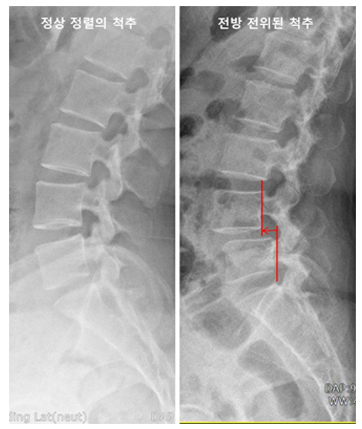
Why does Spondylolisthesis occur and what types are there?
Spondylolisthesis can develop for various reasons: structural deformity present at birth, excessive force applied to the spine during infancy and childhood, degenerative changes with age, or following trauma. In particular, when there is fracture or deficiency of the posterior spinal structures, this is called 'spondylolysis' and is closely related to spondylolisthesis.
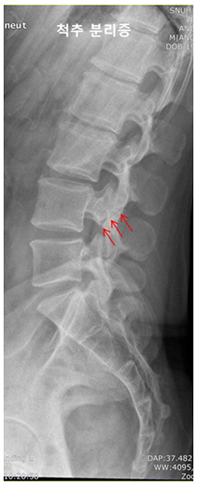
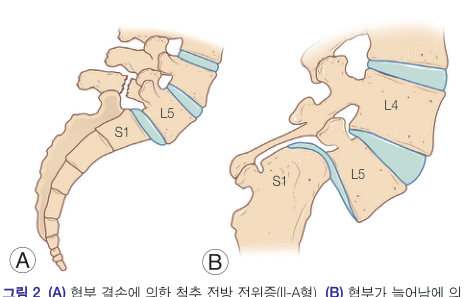
Since spondylolisthesis can develop from diverse causes, it is classified according to the cause or the anatomical shape of the bone defect. This classification facilitates communication among physicians and helps determine the treatment approach.
Is Spondylolisthesis common?
Determining the exact prevalence of spondylolisthesis is difficult because many cases are asymptomatic. While prevalence data for Korea is not available, international data shows that developmental spondylolisthesis occurs in approximately 3% during the growth period, while acquired spondylolisthesis occurs in 5-6% of adult males and 2-3% of adult females. Multiple studies show that spondylolysis and spondylolisthesis are more common in athletes who engage in sports involving excessive backward bending and rotation of the spine.
Among acquired spondylolisthesis, degenerative spondylolisthesis, the most common type, predominantly occurs in women over 50 years of age, with women being approximately 5 times more affected than men. It has been reported that approximately 10% of women over 60 years of age develop degenerative spondylolisthesis.
What symptoms can occur with Spondylolisthesis?
Although many cases of spondylolisthesis are asymptomatic, when symptoms are present, patients typically report lower back or buttock pain and pain radiating down the leg. Symptoms usually develop gradually, persisting over months to years, and may progressively increase in frequency and intensity.
Lower back pain is typically mechanical pain that worsens with movement and improves with rest. Besides symptoms from the spondylolisthesis itself, associated degenerative changes in the spine may worsen with forward bending or sitting, or pain may be exacerbated when extending the back. Patients sometimes report buttock pain rather than pain in the lower back itself.
Pain radiating down the leg is a symptom that occurs as the nerve is compressed due to vertebral misalignment. While uncommon, in severe cases, leg weakness or bowel and bladder dysfunction can occur, and surgery should be considered in such instances.
'Neurogenic claudication' is a symptom pattern where leg pain, numbness, and tingling worsen with walking and improve with squatting or sitting to rest. In severe cases, it can become difficult to walk even a few steps, and surgery should be considered in these situations as well.
Pediatric and adolescent patients present with diverse symptoms, typically manifesting during adolescence when growth is most rapid. Besides lower back, buttock, and leg pain common in adult patients, these young patients may exhibit excessive forward curvature of the spine, tightness and stiffness in the back of the thighs, and an unnatural gait.
How is Spondylolisthesis diagnosed?
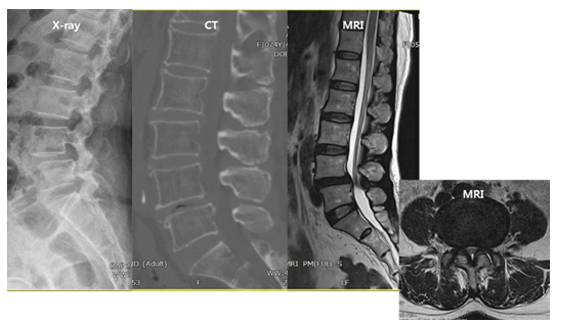
Spondylolisthesis is diagnosed through anteroposterior and lateral X-ray images to assess vertebral alignment. If needed, X-rays taken with the spine flexed and extended may be performed to check for instability of the affected vertebra. X-rays taken at an angle may also be performed to assess for any accompanying spondylolysis.
CT or MRI imaging may be performed for detailed evaluation of the vertebral structures and degree of nerve compression. CT is superior for detailed evaluation of bone tissue, while MRI is better suited for assessing nerves and surrounding soft tissues.
In pediatric patients, bone scan imaging may be performed to differentiate between spondylolysis and acute spinal fracture.
How should Spondylolisthesis be treated?
Treatment for spondylolisthesis is broadly divided into non-surgical and surgical approaches.
- Non-surgical Treatment
Many patients can be successfully treated with non-surgical methods. If vertebral displacement is not severe and there are no neurological symptoms such as leg weakness or bowel/bladder dysfunction, non-surgical treatment can be attempted initially. By limiting activity temporarily and using medications, physical therapy, and when necessary, nerve injection treatment to control pain, surgery may not be necessary. In fact, more patients experience symptom improvement through non-surgical methods than patients requiring surgery.
After pain is controlled, lifestyle habits should be corrected to prevent worsening of vertebral displacement, and consistent exercises to strengthen abdominal and back muscles should be performed to manage the spine. Regular follow-up visits are recommended to monitor the condition.
In pediatric and adolescent patients with acute spondylolysis, bracing may be prescribed for a period to allow healing of the fracture.
- Surgical Treatment
Surgical treatment may be necessary if lower back pain, leg pain, and neurogenic claudication symptoms do not improve with the non-surgical treatment methods described above, or if there is lower limb paralysis or bowel/bladder dysfunction. The goal of surgery is to improve back and leg pain and stabilize the misaligned vertebra to prevent further slippage.
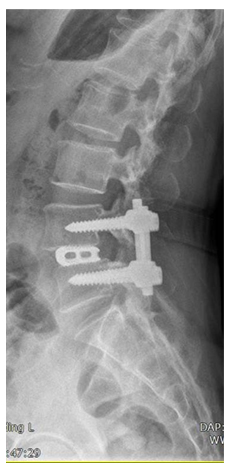
When surgery is indicated, detailed imaging with CT or MRI is performed to assess the exact state of the lesion and formulate a surgical plan. The patient's age, degree of vertebral displacement, associated degenerative changes, and degree of nerve compression are considered to determine the surgical approach. Usually the surgeon approaches from the back to decompress the compressed nerve, and in most cases the displaced vertebra is also fixed with screws so that it cannot slip again. Depending on the patient, the fixation may need to cover a larger area, or the spine may need to be approached from the front.
As with non-surgical treatment, patients who undergo surgery should actively manage their spine and attend regular follow-up appointments to monitor their condition.
What should I do if Spondylolisthesis is found incidentally?
When spondylolisthesis is discovered incidentally without symptoms, no specific treatment is usually necessary. Being aware of your spinal condition and correcting lifestyle habits to prevent deterioration, as well as preventively performing back muscle-strengthening exercises, would be beneficial.
An exception is pediatric and adolescent patients with severe vertebral displacement; if deemed likely to progress with growth, surgery may be necessary.
How should I manage my spine with Spondylolisthesis?
Spine management in patients with spondylolisthesis is not significantly different from general spine management.
First, unhealthy lifestyle habits should be corrected. Obesity and smoking promote degenerative changes in the spine. Also, sitting on the floor or squatting, common in Korean lifestyle, places excessive stress on the spine and surrounding muscles and ligaments. It is recommended to sit on a chair with the back straight when possible. Bending forward and lifting heavy objects should be avoided. Besides these lifestyle modifications, consistent back-strengthening exercises should be performed when pain is not severe. Particularly for patients with spondylolisthesis, exercises that strengthen abdominal muscles rather than extending the back are known to be beneficial.
Medical review: Lumbar Spine Research Society · Provided by the Korean Society of Spine Surgery