It is hardly an overstatement to say that almost no one has never felt pain in the spine. With the heavy workloads, stress, and lack of exercise of modern life, degeneration of the discs and joints of the neck and lower back is expected to advance faster still, and the spinal pain that follows is likely to become an even more serious problem.
Besides pain in the lower back, a fair number of patients have felt pain at the back of the neck or in the arm and hand from a disc herniation or stenosis of the cervical spine, and anyone who has once endured severe pain of that kind knows well how much proper treatment is needed to control it.
Yet among the many treatments available, finding the one that fits you — neither too much nor too little — turns out to be very hard. Over-treating a condition that is not serious can cause side effects or a heavy bill, while treating a condition that truly needs surgery by other means can mean missing the window for treatment or ending up with a poor result.
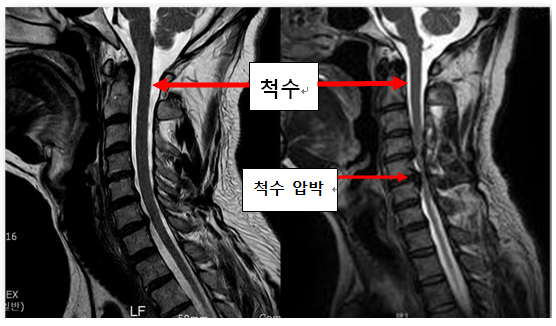
Figure) MRI images of the cervical spine seen from the side, each from a different patient. The thin strand in the center is the spinal cord. In the image on the left the cord is not severely compressed, whereas in the image on the right it is. The patient on the left could be treated conservatively, with nerve procedures and the like, while the patient on the right needs surgery.
As the figure shows, a severe case like the one on the right certainly warrants considering surgery. In practice, though, cases that truly require surgery are not that common: even at a large hospital such as a university hospital, only about 10-20% of the patients seen in the clinic need an operation. Most patients, in other words, improve with non-surgical treatment. Non-surgical care of this kind is called conservative treatment, and it covers a wide range of methods. Common ones include simple physical therapy and rest, exercise therapy, and medication, and for patients whose condition is not severe this much is often enough. When it is not enough, more active treatment is used, and the leading example of that is an interventional procedure. Let us look at cervical procedures in detail.
What are cervical procedures?
When a cervical disc herniation or stenosis causes neck pain or arm pain that does not improve with basic rest, a brace, adequate physical therapy, or medication, a cervical procedure may be considered. Procedures are considered when symptoms persist for a long time or the pain is severe despite ordinary conservative treatment, and they can be tried before surgery. Most are performed under local anesthesia, carry little risk of bleeding, and allow a quick recovery. But a procedure is not automatically safe. Because it treats the nerve directly, a procedure can also cause serious side effects, and care is needed. It also has limited benefit in patients whose disease is severe enough to need surgery, and it can delay the right moment to operate, so the decision deserves careful thought.
How do cervical procedures work? Do they actually remove the herniated disc?
When a disc protrudes, or when stenosis narrows the passage the nerve runs through, the nerve is compressed and irritated, inflammation develops in the nerve itself, and pain follows. The inflammation meant here is not tissue damage from invading bacteria. To put it simply: if the stiff edge of a new shoe rubs the skin over and over, the skin is irritated, turning red at first and then swelling, and in bad cases hurting. That state — the nerve irritated, swollen, and reacting, and pain resulting — is what is meant by inflammation here.
When this inflammation is present, inflammatory substances are released and the nerve generates pain. Most procedures are used to reduce that inflammation and take the pain away. They cannot directly remove the protruding disc or widen the narrowed area, but most pain subsides once the inflammation is cleared.
What procedural methods are available for the cervical spine?
Cervical procedures fall broadly into nerve injections, nerve decompression procedures (neuroplasty), and nucleoplasty. The nerves run down from the brain, branching as they go, until they reach the small, thin nerves at the fingertips and toes. A large trunk descends through the center of the spine, and small nerves branch off it like twigs to reach the whole body. When a disc herniation or stenosis is present, these nerves are irritated or compressed and symptoms appear.
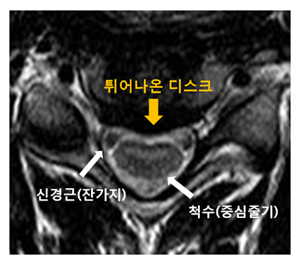
Figure) A cross-sectional MRI of the cervical spine in a patient with a disc herniation. The dark bulge at the front is the herniated disc, which presses on the spinal cord (the trunk) or the nerve root (a twig) and produces symptoms. Compression of a nerve root generally causes pain in the shoulder, arm, or hand, while compression of the spinal cord causes more serious symptoms, such as clumsy hands or an unsteady gait.
Nerve injections and nerve decompression procedures, as noted above, deliver a drug that reduces inflammation straight to the site where the compressed nerve has become inflamed, in the hope of easing the symptoms. A local anesthetic is usually mixed with a steroid for the injection. In nucleoplasty, a kind of heating element is passed through a thin plastic tube into the protruding disc itself, and plasma or electrical heat is applied so that the damaged disc contracts and the volume of the protrusion is reduced. It works much the way a squid shrinks and curls up when you grill it.
Please explain each procedure in detail. Are all cervical nerve injections the same? What medications are used?
What people commonly call a nerve block is the nerve injection. There are three main kinds: epidural injection, nerve root injection, and facet joint injection. As mentioned, the nerve coming down from the brain divides in the middle of the neck into a large trunk and smaller branches that travel throughout the body. Injecting around the membrane of that central trunk is the epidural injection, and injecting around the small branches is the nerve root injection. The facet joint injection is not placed around a nerve at all: the drug goes into the small joints at the back of the spine that are generating the pain.
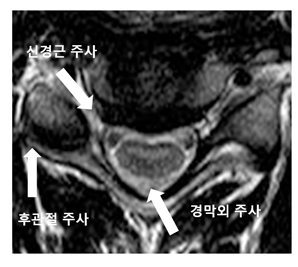
Figure) As shown, injecting around the thin membrane surrounding the spinal cord is the epidural injection; injecting around the opening through which a small nerve root exits is the nerve root injection; and injecting around the small joints at the back is the facet joint injection.
The drugs used are much the same from doctor to doctor, though doses differ. The main ones are a steroid and a local anesthetic. The steroid is a powerful anti-inflammatory that settles the inflammation, while the local anesthetic temporarily dulls sensation in the nerve, reducing pain and sensitivity to it.
The features of each injection are as follows.
- Epidural injection therapy: a steroid (a powerful anti-inflammatory agent, and a kind of hormone found in the body) and a local anesthetic are injected around the dura that wraps the spinal nerves. It is relatively safe and gives immediate relief, but because the drug is not concentrated at a single point, it can be a little less effective than a nerve root injection when the problem is confined to one spot.
- Nerve root injection therapy: the same drugs are used as in an epidural injection but in smaller doses, delivered directly and specifically to one or two small nerve branches. It can act more directly than an epidural injection. However, an important blood vessel called the vertebral artery runs just in front of the opening through which the nerve exits, so the needle must be aimed carefully at the back of that opening to stay clear of it. Even so, a risk of injuring the vessel or the surrounding tissue remains, and placing the drug exactly where it is needed is not easy.
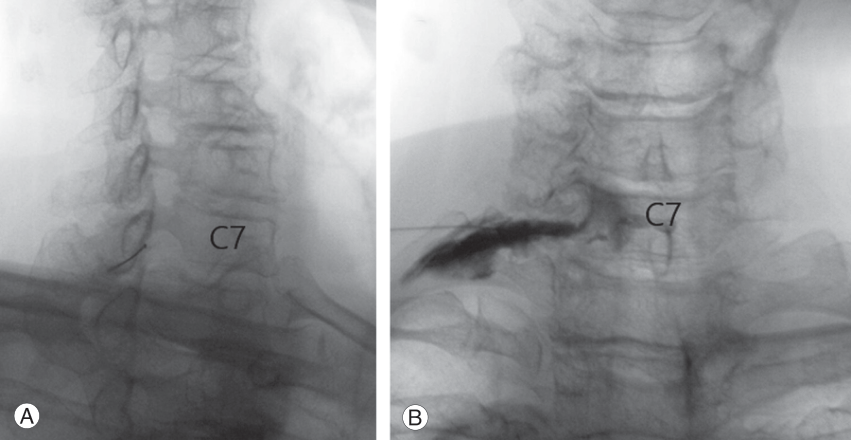
- Facet joint injection therapy: the spine has small joints at the back, and when these degenerate — much as the knee does in osteoarthritis — they can hurt, in which case the drug is injected straight into the joint. Because the injection is not placed around a nerve, it is relatively safe, but its use is limited to conditions such as facet joint syndrome, and it works better for neck pain than for pain radiating into the arm. One caveat: in the neck, the evidence supporting injection straight into the facet joint is still weak. For that reason it is common to first perform a medial branch block — briefly numbing the thin nerve twigs that supply the facet joint — to confirm that the pain really is coming from the facet joint, and to reserve the facet injection for patients in whom it is.
The media often mention nerve decompression procedures. How does that differ from a nerve injection?
Nerve decompression (neuroplasty) is a relatively recent method, performed mainly in private clinics and small and mid-sized hospitals. The technique is as follows.
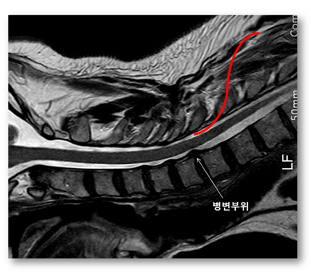
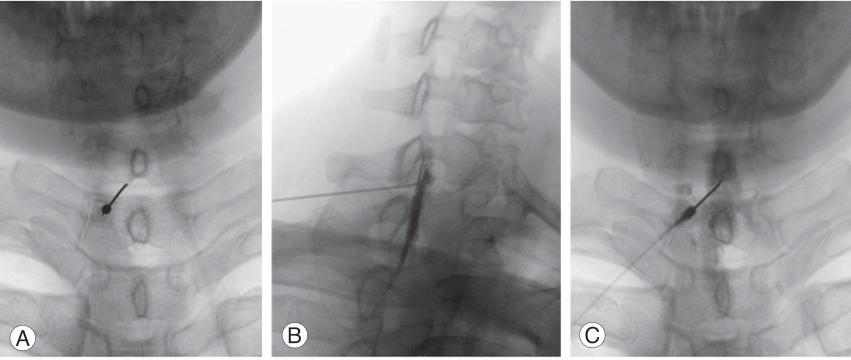
In the Racz method, the best-known form of neuroplasty, the patient lies face down as in the figure above and a thin, long catheter about 2 mm across (shown in red) is inserted from the lower neck up to the level where the disc has herniated. With the catheter in place, a drug that frees up nerve adhesions is injected, followed by a mixture of drugs similar to those used for a nerve injection.
Put simply, it can be seen as an advanced form of nerve injection. Its usefulness and how long the effect lasts, however, remain matters of debate among doctors. Some hold that it differs little from a nerve injection and that the high cost of neuroplasty is not worth it; others hold that it works better than a nerve injection. As noted above, if the disease is severe enough to require surgery, neuroplasty is unlikely to help either. But if nerve injections have been helping and surgery is not immediately needed, neuroplasty may be worth considering so long as the cost stays reasonable.
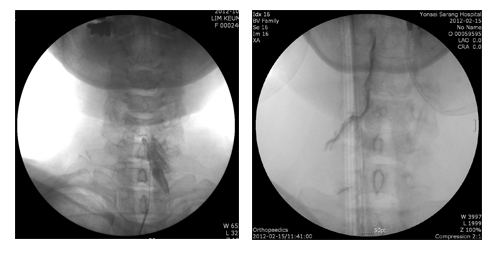
Figure) A photograph taken during an actual neuroplasty. Look closely and you can see the thin catheter entering at the bottom; when contrast is injected through it, the drug can be seen spreading around the nerve as in the image.
Does nucleoplasty really shrink a herniated disc? If it does, wouldn't that make surgery unnecessary?
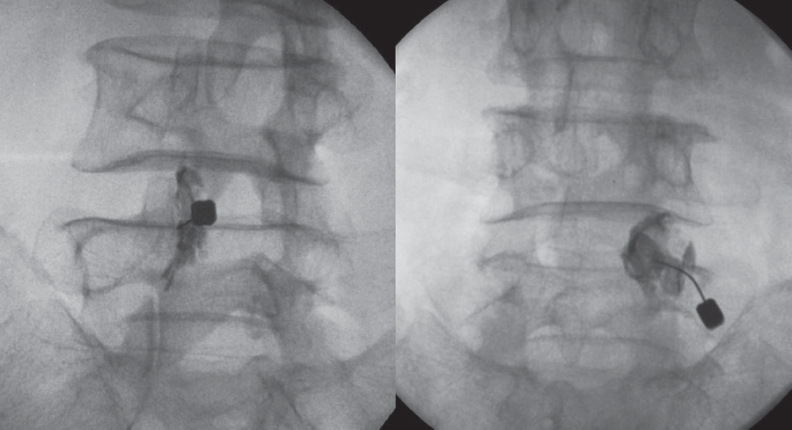
In nucleoplasty, a thin instrument is inserted directly into the herniated disc and plasma or heat is applied to burn away the protruding part, easing the symptoms.
Figure) The two images above show a nucleoplasty being performed, the left taken from the front and the right from the side. A thin instrument is inserted directly to the level where the disc protrudes, dissolving disc material to lower the pressure and give the segment stability.
On some post-procedure images the protruding part of the disc has indeed melted away and the pressure on the nerve has been relieved. That result, however, probably applies only to a fairly limited group of patients, and in most respects there is still no firm evidence on safety or effectiveness. And since the procedure works directly around the nerve, a degree of risk has to be accepted.
Surgery feels like a lot to take on. Can a procedure help me avoid it? How much can a procedure achieve?
However bad their condition, almost no patient wants surgery. No one enjoys the prospect of a general anesthetic and the possibility of complications. But when the disease is severe enough that surgery is truly needed, or when a long delay would lead to a poor outcome, a procedure is unlikely to help and choosing surgery is the right call. The opposite is equally true: operating on someone whose condition is not serious is also wrong. Even fairly severe symptoms often improve with a procedure such as a nerve injection. Surgery should be considered when nothing else has worked, but before that point it is essential to give non-surgical conservative treatment a proper trial.
Refusing surgery outright and rushing into it are both likely to end badly. The right decision is to talk things through fully with a trusted medical team that knows the precise indications, and then decide on a procedure or an operation.
Are cervical procedures safe? Is there really no risk?
It cannot be said that a procedure has no side effects. The cervical spine in particular gives the nerves far less room than the lumbar spine, and blood vessels and other vital structures run very close to them, so it must be understood that a single misstep can cause a serious complication. For example, when a nerve injection or a neuroplasty is performed around the nerve membrane, the drug has to go outside that membrane; if it goes inside by mistake, nerve injury and serious systemic deterioration such as difficulty breathing can follow. It is therefore best to have a thorough discussion beforehand with an experienced specialist. Very rarely, the drug can block a vessel supplying the spinal cord, causing ischemia of the cord and paralysis of all four limbs, or an embolism can reduce blood flow in the brain and cause ischemia of the cerebellum.
Also, a patient with nerve palsy or with myelopathy from spinal cord compression definitely needs surgery. Forcing a procedure in such a case must never be allowed to cause an unexpected complication or to miss the right moment to operate.
In conclusion
As medicine advances, many new treatments are appearing for spinal disease, and the cervical spine is no exception. Because cervical symptoms are often severe, treatment decisions are frequently made in haste. When ordinary conservative treatment has not worked, a cervical procedure can be tried as a non-surgical option, but it must not be over-trusted. After a full discussion with an experienced specialist confirms that the patient truly fits the indications, a procedure can be a good way to treat the cervical spine.
Medical review: Cervical Spine Research Society · Provided by the Korean Society of Spine Surgery